

This month I visited some new theatres for the first time (the Hot Docs Cinema and the Harvard Film Archive) and watched a mix of slashers and experimental avant-garde films.
A Complete Unknown

United States of America | 2024 | 140m | English
… And with that, I’ve seen most of the big contenders for this year’s Oscars.
I put off watching A Complete Unknown for a long time because, frankly, I have zero interest in Bob Dylan. I’ve never been a fan of his music nor had any fascination with the guy. Sorry, he’s just not for me.
Watching this biopic, light on plot but big on musical numbers, I could realize from a detached, objective standpoint that it probably means a lot to some people. It’s shot very well, and the musical performances are totally fine for what they are – again, I just don’t personally care for folk. If I didn’t feel some odd obligation to finish this movie in order to feel “prepared” for the Oscars, I would have turned it off long before it reached the end of its lengthy runtime. I just don’t care about any of these people, their work, or their history. Even I find it a little strange, because I’m a huge fan of music – including a number of artists of this era. But Bob Dylan? Nope. And this movie did absolutely nothing to change that.
Covid Collateral

Canada | 2024 | 79m | English
What’s brilliant about the approach taken by this documentary is that it does not ask questions like “Were lockdowns an effective policy during the COVID-19 pandemic?” or “Did COVID-19 originate in a laboratory in Wuhan?” because to really get to the bottom of such matters would require a degree of careful study that a 79-minute documentary does not have time for and that, frankly, the vast majority of the audience does not possess the specialized, technical know-how to truly grapple with.
Instead, Covid Collateral smartly focuses instead on the question: “Was robust debate allowed during the COVID-19 pandemic?” On that question, the evidence presented by the documentary is irrefutable. We see example after example where dissenters were not refuted, exposed for their misinformation and quackery, but rather shut out of the conversation entirely. Most chillingly, this took the form of censorship by Big Tech that we now know—thanks to the Twitter Files and testimony from Mark Zuckerberg and others who have come forward in the years after the pandemic—was outright compelled by the U.S. federal government. The dissenters highlighted by this movie are not simple laypeople who bristled at the thought of wearing masks; they are accomplished epidemiologists at the top of their field, who were celebrated as experts by the academic, liberal establishment up until the precise moment when they voiced their questions about COVID-era policy assumptions. One of the most notable examples is Jay Bhattacharya, professor of medicine, economics, and health research policy at Stanford University—who, in a great twist of irony, also happens to be the man who will likely become the next Director of the National Institutes of Health.
To stand on the side against the filmmakers of Covid Collateral is not equivalent to saying, “The U.S. government was right, and the dissenters were wrong”; it is equivalent to saying, “The U.S. government was right, and dissenters ought not to have been able to even present their case.” That’s a much different position—one that seeks to find comfort in the face of fear within the warm certainty of totalitarianism and censorship. Is that truly the kind of society we want to live in? The answer for most people, judging by the absence of any real accountability or reckoning in the years after the pandemic, unfortunately seems to be a resounding “yes.” It’s documentaries such as this that may, as they are rediscovered over the years, slowly orient us back towards our societies’ precious liberal-democratic values. Honestly, Covid Collateral will probably only be seen by a limited audience who seeks it out and can tolerate the admittedly dry talking head presentation style, rather than by the apathetic masses who would be best served by being introduced to the alarming information collected here.
(As a side note, there must have been a degree of AI upscaling used on some of the news footage compiled in this documentary, because I noticed strange text artifacting throughout. None of that detracts from the impact of the message, however.)
Now, at Last!

Brazil, United Kingdom | 2018 | 38m | English
Not wanting to give up my regular cinematheque visits during a trip to Boston, I searched for a theater that would act as a TIFF Bell Lightbox away from home. Finding the Harvard Film Archive, I eagerly purchased a ticket to a 35mm showing of Now, At Last!, an avant-garde “sloth movie” presented by its director.
Roughly 40 minutes in length, much of the film shows a sloth laboriously climb up a tree, stop, and fall asleep. It’s filmed in black-and-white and set to the soundtrack of the jungle. Then the movie breaks into a musical segment filmed with a deliberately imperfect version of three-strip color that creates an almost psychedelic effect that the director refers to as “sloth time.”
I found the whole thing to be charming. I loved watching the sloth cutely scratch her nose or leisurely turn her head to nonchalantly gaze around the jungle from her position hanging upside-down from the tree. The close-up shots of her nose and mouth got an audible “aww” from me. Hearing the director speak afterwards, I did not get the sense that Now, At Last! was meant to be a provocative anti-movie in the age of short-form videos or an audience-hostile extreme durational film in the spirit of something like Paint Drying. It really is just a patient ode to wildlife, where we the audience are invited to slow down and share a moment with this wondrous, endearing creature, however long it takes.
Blow Out
United States of America | 1981 | 108m | English
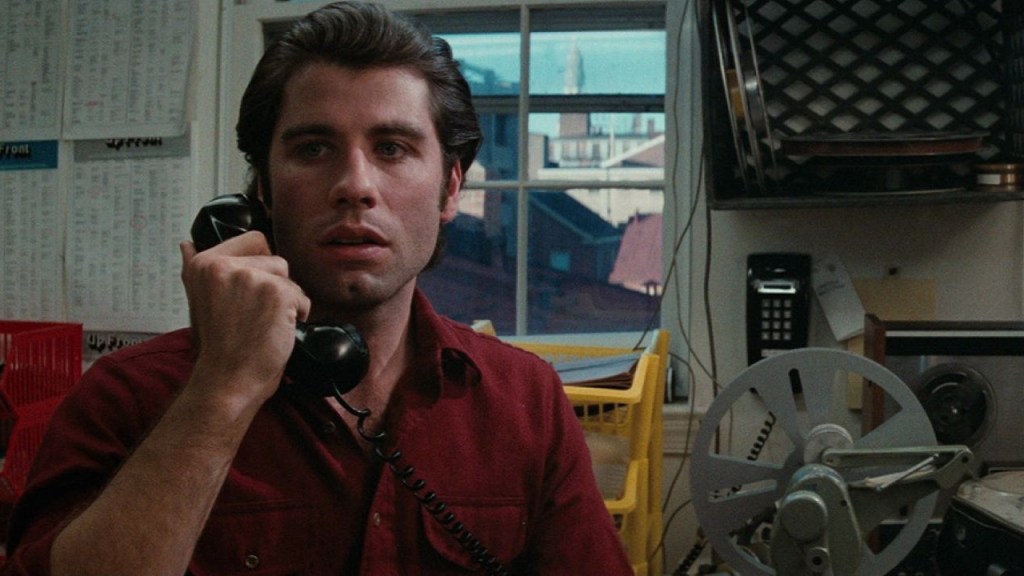
Most of the time, Blow Out felt needlessly lurid to me. Brian de Palma is being his usual sleazy self. (The most comedic moment is when two women take turns pulling each other’s hair to try to make the other scream out in convincing enough pain to overdub a movie scene of a nude woman being murdered in the shower. Meanwhile, men mock all of them for their poor vocal performances.) I’m not so sure what everyone sees in John Travolta’s performance here, either.
On the flip side, de Palma occasionally does interesting and unique things with the camera, including his signature split screen. I loved the focus on all the vintage A/V equipment, for what it’s worth. This story couldn’t really work in the smartphone era. The soundtrack was cool, too. However, the movie suddenly becomes at least 30% more interesting in the way it ends. I’m still trying to puzzle out what exactly the movie is trying to say about America, capitalism, etc. but my gut tells me there’s a there there.
Death Proof
United States of America | 2007 | 113m | English
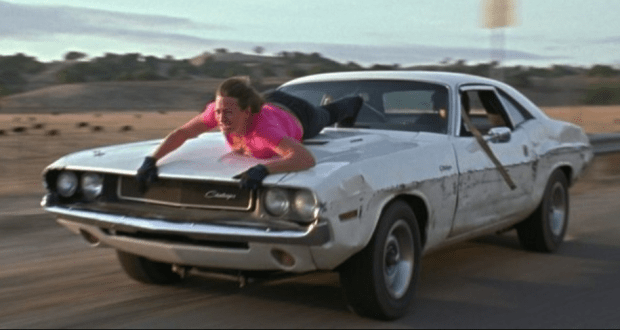
Howard Hawkes says that a good movie is one with “three good scenes and no bad scenes.” Death Proof has three good scenes, for sure. I’d even call them great scenes: the car crash that concludes the first half, the wild car chase at the end of the movie, and… um… the lap dance scene.
The problem is that every other scene is bad. Not just bad but insufferable. Normally I love Tarantino’s dialogue, but in Death Proof he seemed to be under the impression that any word that came from his pen was infinitely and inherently fascinating, no matter how inane the subject or inconsequential to the plot. I actually did like the fake film grain and other simulated imperfections in the film quality, but style without substance can only take you so far. This is by far Tarantino’s weakest film.
Baby Invasion
United States of America | 2024 | 79m | English, Japanese
80 minutes but it felt three times as long. I really wanted to like this because on the whole it’s truly unlike any other movie I’ve ever experienced, and I really, really love the techno soundtrack by Burial. Unfortunately, however, Baby Invasion wears out its welcome remarkably quickly.
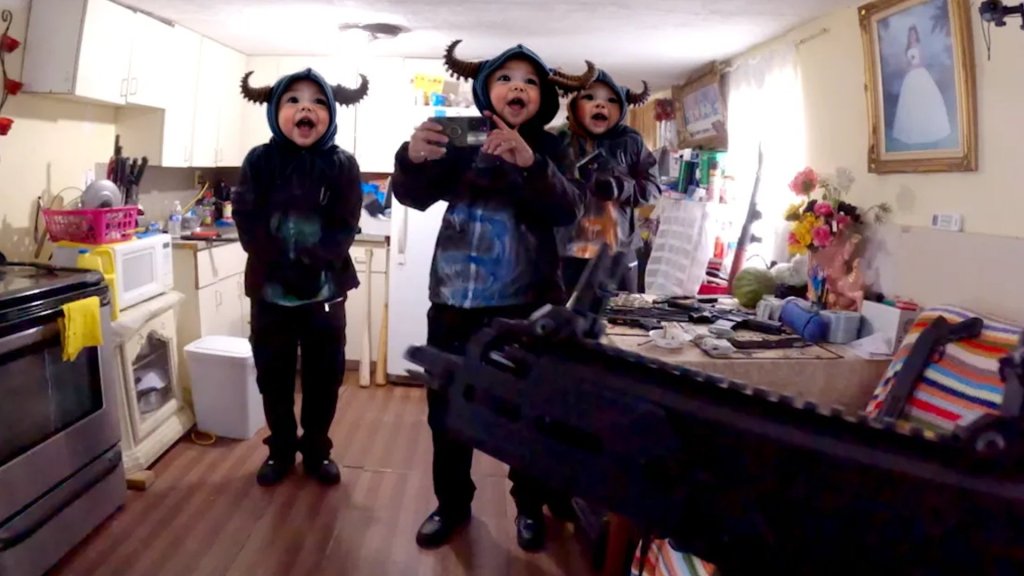
As maximalist as the visuals are, they can’t mask a complete absence of plot or anything else to drive interest in the film. We are simply presented with a series of images, some more coherent than others, often deeply unpleasant, and always garish. What bothered me was that the fake video game HUD wasn’t even consistent or coherent within its own game world logic, so it’s not as if I could deduce a story based on the changing meters and pop-ups littering the screen. (And I could actually read the Japanese!) It’s pure style over substance.
Part of me feels that there has to be some kind of substance here; most likely a commentary on how the internet desensitizes its denizens to scenes of violence and brutality, especially in an age where livestreamed murder and mayhem is not only increasingly common but also increasingly celebrated (the October 7 Go-Pro footage comes to mind). But after several pained sessions of enduring this movie piece by piece, I reached the credits without any insight gained into any of the apparent themes: internet culture, violence, gaming, kill-the-rich philosophies, nada. What a let down!
Star Wars

United States of America | 1977 | 121m | English
I was supposed to watch Heat on 35mm this night at the Revue Theatre, but a fever + a wicked headache dissuaded me from leaving my home tonight. Instead, I indulged my love for 70s cinema by revisiting the most essential of all 70s cinema – that of course being the first Star Wars.
I made it about a half hour through the Disney+ version (and thought to myself, “they focus on the droids at the beginning for way longer than I remember…”) before deciding to pivot to the “4K77” version, a fan edit which promises to restore the movie to as close to its 1977 theatrical state as possible. I had only ever seen variations of the “Special Edition,” so this was a first for me. All in all, I think the changes are relatively minor, although I appreciated knowing that everything I saw on screen was pure 70s effects and technology – none of it marred by superfluous CGI rocks or morally redemptive head dodges from Han Solo. More than the absence of any of George Lucas’s added scenes or effects, the 4K77 edit’s greatest appeal to me is that it retains a healthy amount of film grain (and cue marks!) that really did make me feel like I was seeing exactly what theatre-goers saw in 1977.
Having seen my fair share of New Hollywood-era movies at this point, it’s truly impressive what kind of mesmerizing and exciting visuals Star Wars managed back then. Every frame is oozing with creativity. Add to that the iconic characters, fast-paced, thrilling action, and in my opinion maybe the best music and sound design in all of cinema, and Star Wars still remains one of those lightning-in-a-bottle, timeless movies that exemplify the best the medium has to offer.
Other Movies I Saw This Month
- Citizen Kane (1941) [4/5]
- The Quiet Earth (1985) [2.5/5]
- Popcorn (1991) [2/5]
- Truck Turner (1974) [4/5]
- Scream (1996) [3.5/5]
- Friday the 13th (1980) [1.5/5]
- The Texas Chain Saw Massacre (1974) [4/5]
- Scream 2 (1997) [3/5]
- Snow White and the Seven Dwarfs (1937) [4/5]
- Blue Velvet (1986) [3.5/5]
- Scream 3 (2000) [2/5]
- Rashomon (1950) [4.5/5]
Best Movies I Saw This Month
- Now, At Last!
- The Texas Chain Saw Massacre
- Truck Turner
Worst Movies I Saw This Month
- Friday the 13th
- A Complete Unknown
- Scream 3


 Josh Anderson