

Imagine if every time you asked a librarian for help finding a book, the library would be forced to pay money to that book’s publisher.
A rational observer of this behavior might suggest that the librarian has already done a service to that book’s publisher by handing them a new reader. A rational observer might also be unsurprised when the library decides that they aren’t going to let their librarians direct readers to books anymore because they no longer want to deal with uncertainty and exorbitant costs.

Perhaps, then, it makes a little more sense as to why on June 29, 2023, Google announced that thanks to the Online News Act (formerly known as Bill C-18), they “will have to remove links to Canadian news from our Search, News and Discover products in Canada.” This comes after Meta announced, that same month, that “news availability will be ended on Facebook and Instagram for all users in Canada prior to the Online News Act (Bill C-18) taking effect.”
This is a rational response to an irrational premise now codified into Canadian law: that to link to a news article online is to “steal” value from that article.
Normally, if someone is stealing and you ask them to stop – and they do – you would move on, satisfied. You wouldn’t then start calling them a bully for… not stealing anymore(?) I’m picturing an armed assailant, mid-mugging, handgun pointed at his victim, his face reddening and his voice rising, “What do you mean you won’t hand over your money? Stop bullying me! You stop bullying me!”
This isn’t about websites plagiarizing journalists’ work, posting entire articles without attribution and slurping up all of the advertisement revenue for themselves. This is about information access, period. When an exemption for hyperlinks was suggested, Liberal MP Chris Bittle rejected the idea on account of its being a “loophole.”
Based on their June 29 blog, Google fully understands how incredibly far-reaching (and asinine) the Online News Act is, describing how “the unprecedented decision to put a price on links (a so-called ‘link tax’) creates uncertainty for our products and exposes us to uncapped financial liability simply for facilitating Canadians’ access to news from Canadian publishers.” Earlier, Google testified to the Senate that the government was making “Canada the first country in the world to put a price on free links to webpages.” The uncertainty is the sticking point; the Act forces platforms to pay not for what they post themselves, but for whatever appears on their platform, with no limit on what that payment might be. They are forced to write a blank check for whatever their users (or whatever their competitors’ bot armies) decide to post now and until the end of time.

Come to think of it, do I, a Canadian, need to start paying money to the news organizations I link to? The answer, it would seem, is no. The “Application” section of the Bill reads as follows:
Application
6 This Act applies in respect of a digital news intermediary if, having regard to the following factors, there is a significant bargaining power imbalance between its operator and news businesses:
Source: https://www.parl.ca/DocumentViewer/en/44-1/bill/C-18/royal-assent
- (a) the size of the intermediary or the operator;
- (b) whether the market for the intermediary gives the operator a strategic advantage over news businesses; and
- (c) whether the intermediary occupies a prominent market position.
At one end of the spectrum sit blogs like mine, too tiny to fall under the purview of the Act. At the other end are your Googles and Metas. They’ve seen the writing on the wall and made their decision to pull news access so that they can preemptively prevent their exposure to unrestricted financial liability. But what about the platforms in between – the LinkedIns, Reddits, Twitters, and Discords? It will be up to the Canadian Radio-television and Telecommunications Commission to decide which of these are large enough to be considered “digital news intermediaries” and subject to potentially ruinous link taxes.
As it stands, if I share a link to a news article via Facebook, the Canadian government views that link as providing value and subject to payment. If I post that exact same link to my blog, it does not provide enough value to warrant payment. But If I share that exact link on Twitter, the Canadian government… probably doesn’t see that link as providing value, at least for now. Apart from nonsensical idea that the same link posted by the same person is “valuable” on one platform but not “valuable” on another, it is not reasonable to expect companies that merely host hyperlinks to operate under such crushing uncertainty. If you ask me, the uncertainty is precisely the point – if you’re a digital platform, you’d better carefully toe the party line lest any of its cronies come to the sudden realization that your company hasn’t been paying its “fair share.” It would not surprise me if other big tech platforms follow Google and Meta’s lead on throttling news access in Canada to avoid the ever-present risk of one day getting financially kneecapped by the government out of the blue.
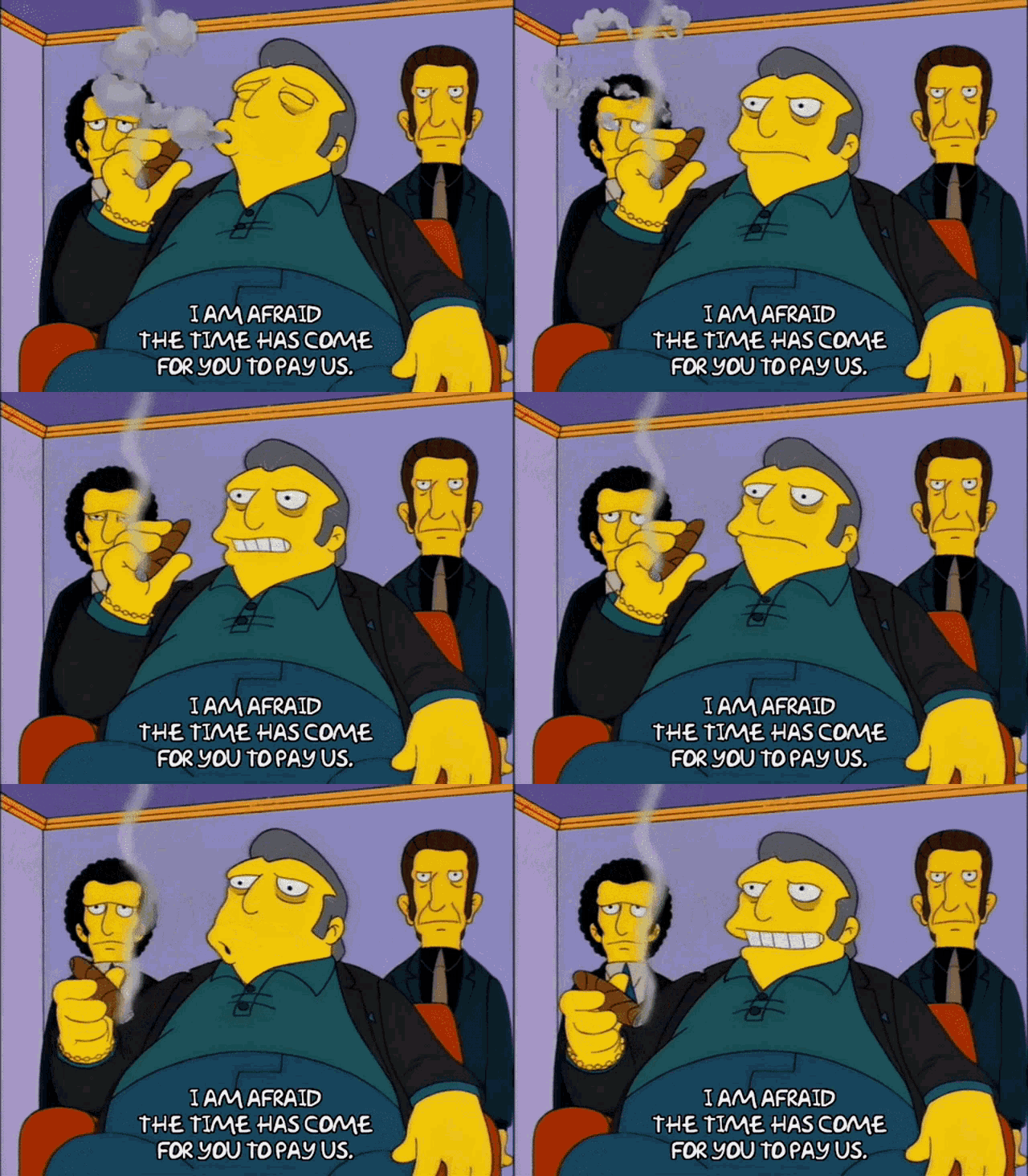
I don’t even particularly like Big Tech. But you know what I really don’t like? Governments interfering with their citizens’ ability to share and access information online for the sake of nationalist politics.
When I complained about Big Tech forcibly preventing users from sharing verifiably true information concerning a Presidential candidate during an election, it was because I didn’t want them to ever do that again – not because I wanted them to do that all the time for everything!
Hey, maybe it’s not all bad. Ironically, with the Online News Act, the Canadian government has bitten the hand that feeds it. The very group this Act sought to help, the big Canadian news outlets, will be hurt the worst. That includes the one that’s majority government-funded and publishes such gems as “Medically assisted deaths could save millions in health care spending: Report.” I don’t have the login to our state broadcaster’s Google Analytics account, but I’ve worked in digital marketing for long enough to know that it’s going to be a rough day when their inbound traffic from Google search results and Facebook shares drops to zero.
Smaller, more independent platforms who have yet to be cursed with the label “digital news intermediary” will enjoy a window of opportunity where they can provide news to Canadians without a link tax. Realistically, however, this will probably end with Big Tech platforms striking private deals with publishers, which as I understand it is what happened in Australia when they went through a similar rigamarole. Think something along the lines of, “We’ll pay you X for links to your articles as long as you don’t write about Y.” What are X and Y? We’ll never know. As OpenMedia points out, this kind of secret, backroom dealmaking is not good for transparency, fairness, trust, or democracy. Hopefully by the time Canadian news links are restored, however, people will have migrated to alternative news outlets that have found a business model that allow them to thrive while respecting the free movement of information online.


 Josh Anderson